
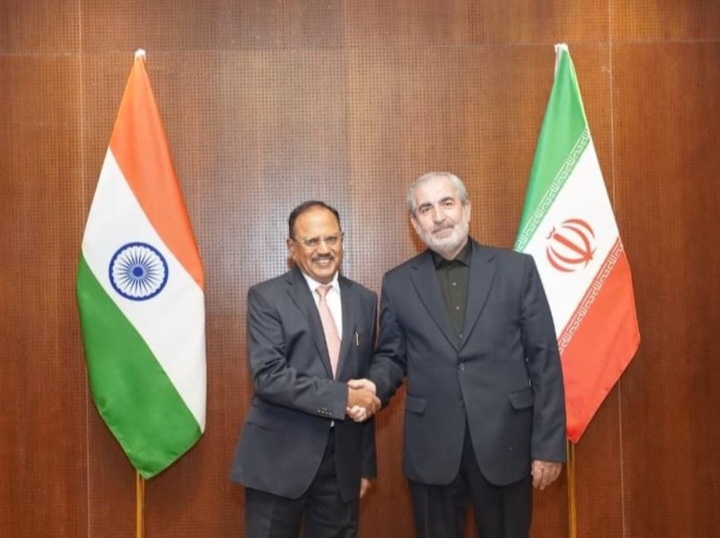
NSA Ajit Doval, Sergei Shoigu discuss BRICS cooperation and bilateral ties in New Delhi
New Delhi(24/06/2026) By Subham Bose : India's National Security Adviser Ajit Doval and Sergei Shoigu held high-level discussions in New Delhi on strengthening bilateral strategic ties and enhancing cooperation within the BRICS framework.The meeting reflected the continued commitment of India and Russia to deepen their long-standing strategic partnership amid evolving global geopolitical and security challenges.The talks covered a wide range of issues, including regional and global security, defence cooperation, counter-terrorism, connectivity initiatives, and collaboration among BRICS member nations.Both sides reaffirmed the importance of maintaining regular high-level engagement and expanding cooperation in areas of mutual strategic interest.The meeting comes at a time when BRICS is playing an increasingly significant role in global governance, with member countries seeking to strengthen cooperation on economic development, financial stability, technological innovation, and security issues.India and Russia reiterated their shared commitment to promoting a more balanced, inclusive, and multipolar international order through multilateral platforms.During the discussions, Doval and Shoigu reviewed the progress of the India– Russia Special and Privileged Strategic Partnership, which has remained a cornerstone of bilateral relations for decades.They emphasized the importance of continued collaboration in defence, energy, space, science and technology, and emerging areas such as cybersecurity and critical technologies.Both leaders acknowledged the strong foundation of trust that has characterized relations between New Delhi and Moscow and expressed satisfaction over the steady pace of bilateral engagement despite changing global dynamics.The meeting also provided an opportunity to review ongoing defence cooperation, including joint military exercises, defence production, technology transfer, and efforts to further strengthen military-to-military exchanges.Counter-terrorism emerged as one of the key themes during the discussions.Both sides reiterated their firm commitment to combating terrorism in all its forms and manifestations, emphasizing the need for greater international cooperation to address cross-border terrorism, violent extremism, and emerging security threats.The two officials also exchanged views on regional developments and evolving security situations in different parts of the world.They stressed the importance of respecting the sovereignty and territorial integrity of nations while promoting peaceful dialogue and diplomatic solutions to international conflicts.Cybersecurity, intelligence sharing, and efforts to counter transnational organized crime were also discussed as areas requiring closer coordination between the two countries.A significant part of the meeting focused on strengthening collaboration within BRICS, which has expanded its global influence in recent years.Doval and Shoigu discussed ways to enhance coordination among member nations on issues relating to economic resilience, sustainable development, financial cooperation, counter-terrorism, and global governance reforms.Both sides emphasized that BRICS has emerged as an important platform for advancing the interests of emerging economies and promoting greater representation of developing nations in international institutions.They also highlighted the importance of maintaining close consultation ahead of future BRICS meetings to ensure coordinated positions on major international issues.In addition to traditional areas of cooperation, the two leaders explored opportunities to deepen collaboration in emerging technologies, artificial intelligence, digital security, and resilient supply chains.As technological competition becomes increasingly central to global strategic affairs, both countries recognized the importance of strengthening partnerships in innovation and critical infrastructure protection.Energy security, including cooperation in oil, natural gas, nuclear energy, and renewable technologies, also featured prominently during the discussions, reflecting the growing importance of energy collaboration in bilateral relations.The meeting reaffirmed the enduring nature of India–Russia relations, which continue to be marked by regular political dialogue, defence collaboration, and economic engagement.Officials from both sides stressed that sustained communication between national security establishments remains essential for addressing shared challenges and identifying new areas of cooperation.Analysts believe the discussions underscore the strategic significance that both countries attach to their bilateral partnership at a time of shifting geopolitical alignments and increasing emphasis on multilateral cooperation through forums such as BRICS.As India and Russia continue to engage across diplomatic, economic, and security domains, the talks between Ajit Doval and Sergei Shoigu are expected to further strengthen mutual trust and contribute to greater coordination on regional and global issues.The meeting also highlighted the shared commitment of both nations to promoting peace, stability, and a rules-based international order through dialogue, strategic cooperation, and active participation in multilateral institutions.
Trending

7.5-magnitude quake strikes Venezuela seconds after Foreshock

Government reiterates Ethanol Blending Programme is scientifically validated and continuously monitored

Cabinet reshuffle buzz grows after George Kurian's exit; major changes in Modi Government expected soon

Ministry of Mines auctions 10 critical mineral blocks under 7th tranche

Odisha strengthens Kharif 2026 preparedness following review by Union Agriculture Minister
Visit Our Odia News Site