
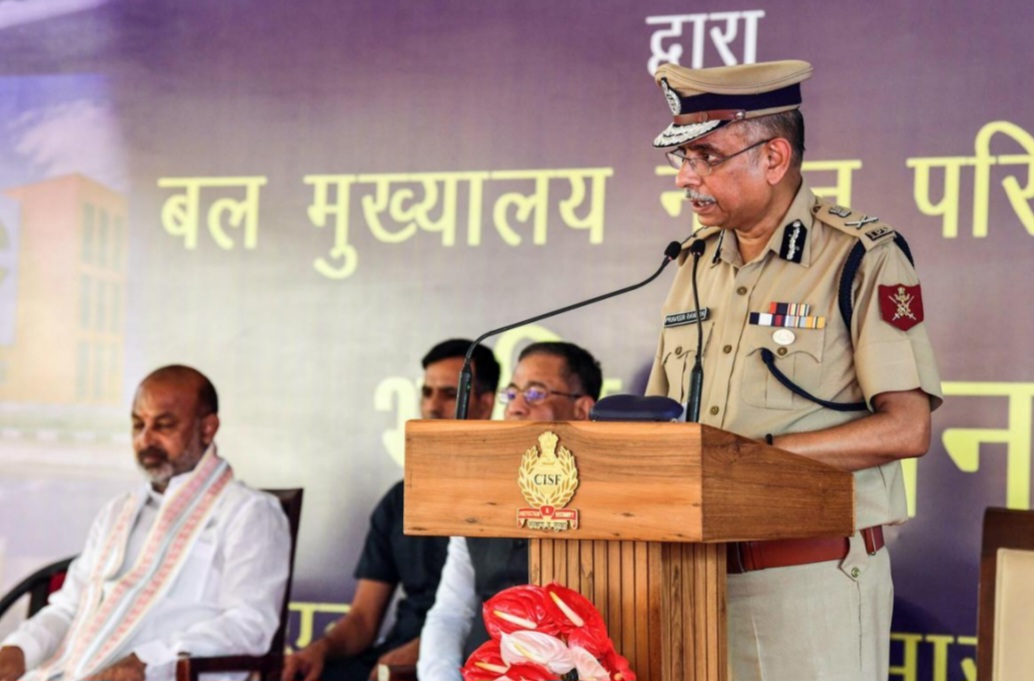
Facial recognition cameras at airports, vital sites to be linked to data fusion centre: CISF DG
New Delhi(23/06/2026) By Subham Bose: In a major step towards strengthening India's security architecture, the Director General (DG) of the Central Industrial Security Force (CISF) has announced that facial recognition cameras installed at airports and other vital installations across the country will soon be integrated with a centralised data fusion centre.The move is aimed at enabling faster threat detection, improving surveillance capabilities, and enhancing real-time intelligence sharing across security agencies. The proposed integration is expected to significantly bolster the country's ability to identify suspects, monitor potential security threats, and respond swiftly to emergencies at critical infrastructure such as airports, metro networks, ports, power plants, and government establishments protected by the CISF. According to the CISF chief, the data fusion centre will function as a central hub that collects, analyses, and processes information received from multiple surveillance systems deployed at protected locations.By linking facial recognition-enabled cameras to the platform, security personnel will be able to verify identities more efficiently and detect individuals who may be on security watchlists or linked to criminal or terrorist activities. The initiative forms part of the CISF's broader effort to modernise security operations by leveraging advanced technologies, including artificial intelligence (AI), machine learning, predictive analytics, and integrated surveillance systems.Officials believe that technology-driven policing will improve situational awareness while reducing response times during security incidents. India's airports have witnessed a steady expansion of digital security infrastructure over the past few years.Several major airports already use sophisticated CCTV networks, biometric systems, and facial recognition technology to facilitate both passenger movement and security screening.Integrating these systems with a national data fusion platform is expected to provide a more comprehensive and coordinated security framework. The CISF, which guards over 350 critical installations across the country, has increasingly adopted smart surveillance solutions to address evolving security challenges.These include drone detection systems, intelligent video analytics, command-and-control centres, and cyber monitoring tools that support personnel in identifying suspicious behaviour and preventing potential threats. Officials noted that the data fusion centre would not merely collect footage but would analyse information from diverse sources, including CCTV feeds, access-control systems, alarm networks, and intelligence inputs.Such integration would help security agencies identify patterns, generate alerts, and coordinate responses more effectively across multiple locations. The announcement comes at a time when global aviation and critical infrastructure security continue to face complex challenges ranging from terrorism and organised crime to cyber threats and unauthorised intrusions.Security experts have increasingly advocated the use of AI-enabled surveillance systems to complement conventional security measures and improve operational efficiency. While the deployment of facial recognition technology has been welcomed by many security professionals for its potential to strengthen public safety, it has also reignited discussions around data privacy and the responsible use of biometric information.Experts emphasise that such systems should operate within a robust legal and regulatory framework, ensuring that personal data is protected against misuse while maintaining transparency and accountability. The CISF has maintained that technological advancements are intended to assist security personnel rather than replace human decision-making.Officers monitoring the integrated systems will continue to assess alerts and verify information before taking any operational action. The force has also invested significantly in training its personnel to operate advanced surveillance platforms and interpret AI-generated intelligence effectively.Regular cybersecurity audits, system upgrades, and inter-agency coordination exercises are expected to form an integral part of the new security ecosystem. As India continues to modernise its aviation infrastructure and expand critical public assets, the integration of facial recognition cameras with a centralised data fusion centre represents a significant milestone in the country's security strategy.By combining cutting-edge technology with coordinated intelligence sharing, the CISF aims to build a more proactive, responsive, and resilient security network capable of addressing both conventional and emerging threats while ensuring the safety of millions of citizens who use the nation's critical infrastructure every day.
Trending

7.5-magnitude quake strikes Venezuela seconds after Foreshock

Government reiterates Ethanol Blending Programme is scientifically validated and continuously monitored

Cabinet reshuffle buzz grows after George Kurian's exit; major changes in Modi Government expected soon

Ministry of Mines auctions 10 critical mineral blocks under 7th tranche

Odisha strengthens Kharif 2026 preparedness following review by Union Agriculture Minister
Visit Our Odia News Site